In short: biohazard cleanup is the professional removal, cleaning, and disposal of blood, body fluids, and other biologically contaminated material, done with protective equipment and legal waste handling. You need it when contamination is more than a surface spill, and you should not have to handle it yourself.
Biohazard cleanup, also called biohazard remediation, is the specialized work of removing and safely disposing of material that may carry disease-causing organisms. That usually means blood, other body fluids, tissue, sewage, and waste, along with the materials they have soaked into. It is not the same as a deep clean. The goal is to remove the contamination, not just make the surface look clean, and to do it without putting anyone at risk.
At Post Trauma Scene Decon, we do this work across North Country New York. Our founder, James Smith, is a service-disabled veteran and former police officer and crime scene technician with more than 20 years of experience, and he built this company to be the kind of help he wished families had when he was the one responding to the scene. You can read more about our biohazard cleanup service or our trauma scene cleanup service.
What Counts as a Biohazard?
A biohazard is any biological substance that can make people sick. In cleanup work, the main concerns are bloodborne pathogens, which are microorganisms in human blood that can cause disease, along with bacteria and viruses found in sewage, feces, and decomposing remains. Federal workplace rules treat this seriously. OSHA's Bloodborne Pathogens Standard requires employers to protect workers who may be exposed to blood or other potentially infectious material, including training, protective equipment, and safe disposal.
The key point for homeowners is that you cannot tell by looking whether material is dangerous. Dried blood and old stains can still carry risk, and fluids that have soaked into a carpet or subfloor are out of sight but not out of reach. That is why we treat the scene as contaminated until it has been properly cleaned and cleared.
When Do You Need Biohazard Cleanup?
These are the situations we are called to most often in the North Country.
Death scenes
Unattended deaths, suicides, and other deaths where blood or body fluids are present. Decomposition adds contamination that spreads into flooring and structure the longer it goes untreated.
Crime and trauma scenes
After law enforcement releases a scene, blood and other fluids remain on surfaces and inside porous materials. This work cannot start until the scene is officially released.
Sewage backups
Sewage water carries bacteria and viruses. It is treated as a biohazard because the contamination soaks into drywall, flooring, and insulation.
Human or animal waste
Heavy contamination from incontinence, neglect, or animal hoarding. Urine and feces saturate subfloors and keep producing odor and health risk.
Hoarding with biological contamination
When clutter is mixed with waste, rodent droppings, spoiled food, or mold, it moves past junk removal and into remediation.
Needles and sharps
Discarded syringes and other sharps require special containers and handling to prevent needlestick injuries.
Blood spills
Larger spills that have soaked into carpet, pad, or subfloor. A small surface spill is a different matter than blood that has penetrated materials.
If you are not sure whether your situation qualifies, call and describe it. We would rather tell you honestly that you do not need us than have you guess. For smaller problems such as a minor, surface-level spill with no soaking into materials, we will explain what is reasonable to handle yourself and what is not.
Why It Is Not a Do-It-Yourself Job
Families often ask whether they can just clean it themselves, especially when cost is a concern. We understand the instinct, and in some very limited cases a small spill can be handled with care. For most real biohazard situations, there are four problems with doing it yourself.
Health risk
Pathogens can enter through skin cuts, eyes, or mouth. Professional protective equipment and decontamination procedures exist for a reason.
Hidden contamination
Fluids travel. They wick into carpet pad, seep through subfloor seams, and run down wall cavities. Cleaning the visible stain leaves the rest behind, along with its odor.
Disposal rules
Contaminated material is regulated waste. It cannot simply go out with the household trash, and improper disposal can create legal trouble for the property owner.
The emotional cost
Cleaning up after the death of someone you love, or a violent event in your home, is a burden no family should carry if they can avoid it.
We cover this in more detail in our guide on why you should never clean a crime scene yourself.
What Does Biohazard Cleanup Involve? Step by Step
Every job is different, but a properly run biohazard cleanup follows the same basic sequence. Knowing it ahead of time makes the first call easier.
Assessment and scope
We inspect the property, photograph the conditions, and measure the affected areas. You get a written scope before work begins.
Containment and setup
We isolate the work area, set up HEPA filtration, and control who and what moves through the space so contamination does not spread to clean areas.
Removal of contaminated materials
Carpet, pad, drywall, insulation, and other porous materials that absorbed contamination are removed and packaged in labeled biohazard containers.
Cleaning and disinfection
Remaining surfaces are cleaned and treated with EPA-registered disinfectants. Hard, non-porous surfaces can often be saved.
Odor control and air cleaning
Where odor is part of the problem, we use ozone or hydroxyl treatment along with HEPA air filtration after the source is gone.
Disposal and documentation
Biohazard waste goes out through a licensed waste provider with a manifest. We photograph the finished work and provide the paperwork insurers and property owners ask for.
Final walk-through
We walk the property with you before we call it complete, and we tell you plainly if any structural repair is needed from another contractor.
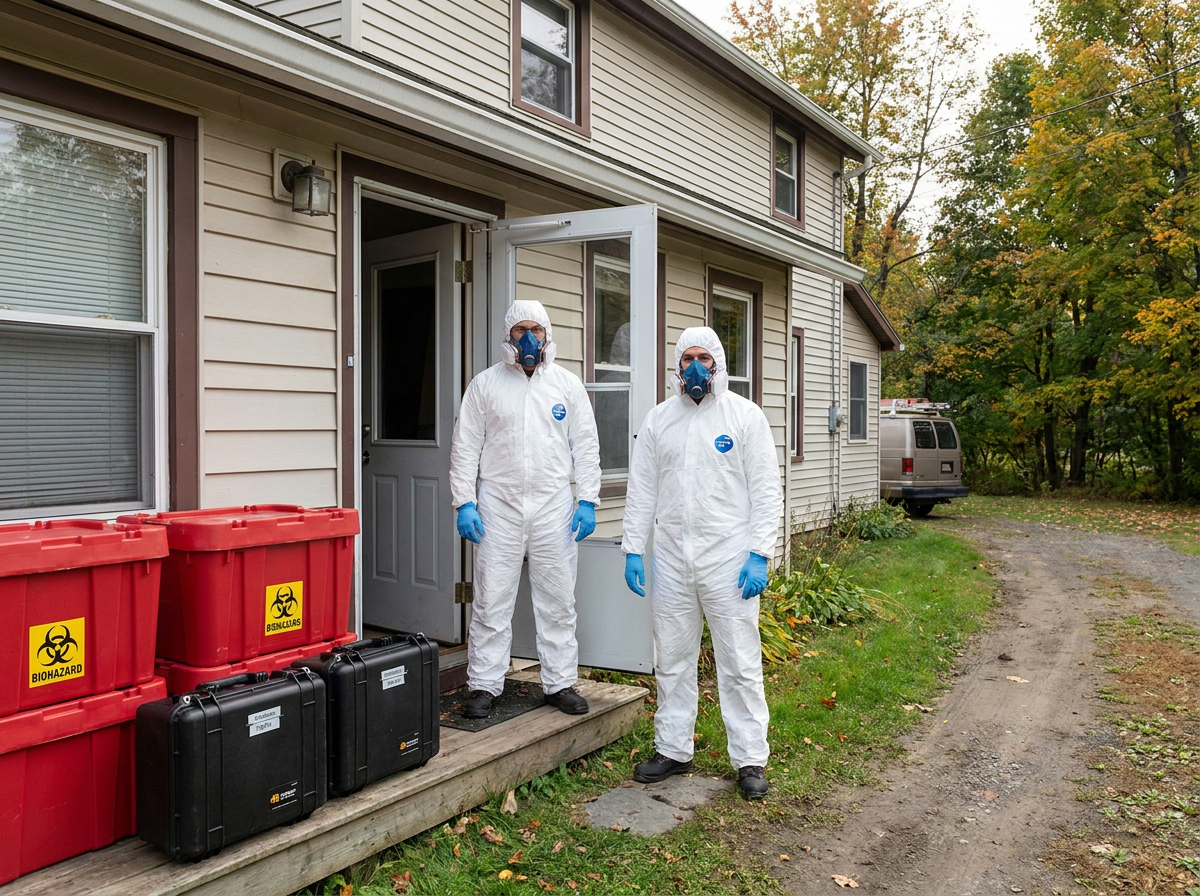
Throughout the job, technicians wear protective suits, respirators, gloves, eye protection, and boot covers, and equipment is decontaminated before it leaves the property so contamination does not travel to the next job. Standards for this kind of work are set by organizations like the IICRC, and we follow them.
If the scene involves a death or a crime, do not start cleaning and do not let anyone else start until law enforcement and, where applicable, the coroner or medical examiner have released it. We never begin work on a scene until it has been officially released.
What to Do in the First Hour
When you discover a biohazard situation, the first few decisions matter. You do not need to have everything figured out. These steps protect you and make the cleanup simpler.
- •Make sure everyone is safe. If someone is hurt or a death has occurred, call 911 first.
- •Stay out of the contaminated area and keep children and pets away from it.
- •Do not touch, move, or clean anything while law enforcement is involved. Wait for the scene to be released.
- •Open exterior doors or windows only if it is safe to do so and no one has told you to leave the scene undisturbed. Do not run fans that push air through the rest of the home.
- •Take note of what you know: when it happened, which rooms are affected, and who has access to the property.
- •Call your insurance agent to open a claim, and call us. We can often help you work out what to tell the adjuster.
Just as important is what not to do. Do not pour bleach on the area, do not scrub with household sponges and throw them in the trash, and do not vacuum. Each of those can spread contamination or release it into the air. Wait for professionals.
How It Differs From Regular Cleaning and Junk Removal
It helps to know what you are paying for. A regular cleaning company cleans surfaces. A junk removal company hauls items away. Neither is set up to handle materials that carry infectious risk, and neither is expected to follow the rules for bloodborne pathogens or regulated waste.
Biohazard remediation adds several things on top of cleaning: trained technicians in protective equipment, containment so the problem does not spread, removal of porous materials that cannot be made safe, EPA-registered disinfection, odor treatment, licensed disposal with a paper trail, and documentation for your insurer. If a company cannot explain how it does each of those, it is not a biohazard company, whatever its ad says.
A related point: the cheapest quote is rarely the lowest cost. If a contractor skips the removal of contaminated flooring or leaves hidden fluid behind, the odor returns, the problem can come back in the structure, and you end up paying twice. A thorough job done once is almost always the better value.
How Long It Takes and What You Can Expect
Many residential jobs can be finished in a single day, often six to eight hours. That surprises people who expect days of disruption. Larger properties, extended decomposition, or heavy structural contamination can take longer, and we will tell you up front if a job needs more than one day. We also tell you early if something we find changes the scope, such as mold behind a wall or damage to the framing, and we document it with photos so you and your insurer see exactly what we saw.
For safety, family members and property owners stay outside the containment area while the work is underway. This is an OSHA-related requirement and it protects you. It does not mean we leave you in the dark. We keep you updated, answer questions plainly, and walk the property with you at the end.
What Does Biohazard Cleanup Cost, and Does Insurance Pay?
Cost depends on the type of scene, how far the contamination spread, how much material has to be removed, and how long the job takes. Because those factors cannot be judged from a phone call, we give a written estimate after we see the property. Our full breakdown is in biohazard cleanup cost and how insurance billing works.
Many homeowner and landlord policies cover biohazard cleanup when it follows a covered loss, and we work directly with adjusters, providing photos, measurements, and a written scope. Insurance and government clients pay after the job is complete. Private clients pay half to schedule and the balance on completion, and payment plans are available through Acorn Financial. If you are unsure where to start, call us first. We will walk you through it.
How to Find a Certified Biohazard Cleanup Company
Not everyone who advertises biohazard cleanup is equipped to do it properly, and when you are in a crisis it is hard to tell the difference. Here is what to look for.
- IICRC-trained technicians. The IICRC sets widely used standards for cleaning and restoration. Ask which technicians hold which certifications.
- OSHA bloodborne pathogens compliance. Workers handling blood and body fluids need bloodborne pathogens training and the right protective equipment. This is a legal requirement, not an extra.
- New York State licensing and waste handling. Ask how they dispose of regulated waste and whether they will give you a manifest. A company that plans to put it in a dumpster is not qualified.
- A written, itemized estimate after an on-site look. A price quoted sight unseen is a guess. Look for a scope that lists what will be removed, treated, and documented.
- Experience with insurers. Photos, measurements, and a clear scope are what adjusters need. A company that does this regularly makes your claim easier.
- Fast, local response. Contamination spreads and odors set in over time. A local company with 24/7 response can usually reach you sooner than a franchise call center.
- Discretion and compassion. You are often calling on one of the worst days of your life. The company should treat you and the property with respect.
We go deeper on this in our guide to how to choose a biohazard cleanup company, including the questions to ask and the red flags that should make you hang up.
Related Situations We Handle
Biohazard work often overlaps with other problems. A sewage backup brings its own health risks and water damage, which we cover in our post on sewage backup cleanup. When a death goes undiscovered, decomposition changes how fast contamination spreads, as we explain in our unattended death cleanup guide. If you are dealing with the aftermath of a traumatic event, our step-by-step guide to what to do after a trauma scene can help you decide what to do first.
Who We Are
Post Trauma Scene Decon is a locally owned company serving St. Lawrence, Franklin, Clinton, Essex, Lewis, and Jefferson counties. We are IICRC certified, OSHA compliant, and BBB accredited, and we hold SDVOB and HUBZone certifications. In 2025 we received the BBB Torch Award for Ethics. We are not a national franchise or a call center. When you call, you are reaching the team that will show up, and we respond within 24 hours, often sooner.
We lead with compassion because the people who call us are usually having one of the hardest days of their lives. The credentials matter, and so does the way you are treated while we use them.
Frequently Asked Questions
Is biohazard cleanup the same as crime scene cleanup?
Crime scene cleanup is one kind of biohazard cleanup. Biohazard cleanup also covers unattended deaths, sewage backups, heavy contamination from waste, and other situations with no crime involved.
Can I clean up a biohazard myself?
For anything beyond a very small, surface-level spill, we recommend against it. Blood and body fluids can carry pathogens, and household products do not reach material the fluid has soaked into. Removal and disposal also have legal requirements.
How long does biohazard cleanup take?
Many residential jobs can be completed in a single day, often six to eight hours. Larger properties or heavier contamination can take multiple days. We tell you what to expect after the assessment.
Will insurance pay for it?
Often, yes, when the cleanup follows a covered loss. Coverage depends on your policy and what happened. We provide the documentation adjusters need and work with them directly.
Do I need to be there?
No. For safety reasons, family and property owners stay outside the containment area while work is underway. We will keep you updated, and we do a walk-through with you at the end.
Can you work discreetly?
Yes. If privacy matters to you, tell us when you call. We can arrive in an unmarked vehicle and keep our setup low-profile.
What areas do you serve?
We serve St. Lawrence, Franklin, Clinton, Essex, Lewis, and Jefferson counties, including Malone, Plattsburgh, Watertown, Massena, Potsdam, and Canton, and we answer calls around the clock.
Post Trauma Scene Decon provides biohazard cleanup, trauma scene cleanup, mold remediation, hoarding cleanup, and odor removal across St. Lawrence, Franklin, Clinton, Essex, Lewis, and Jefferson counties in Northern New York. IICRC certified. OSHA compliant. BBB accredited. SDVOB and HUBZone certified. Available 24/7.
Not Sure What You Need? Call and Ask.
Describe what happened and we will tell you honestly what it takes. No pressure, no judgment. Available 24/7 across North Country NY.
Call (315) 250-4462