If you are asking about biohazard cleanup cost, you are probably in the middle of one of the hardest situations you have faced. The financial questions are real, and they deserve straight answers — not vague ranges or disclaimers. This guide is written to give you a clear picture of what certified biohazard remediation costs in Northern New York, why, and what your insurance policy may actually cover.
Biohazard cleanup cost is one of the most searched questions in our industry — and one of the most poorly answered. Most online resources give national averages that have no connection to the actual cost of a specific job in a specific location with a specific type and extent of contamination. That is not useful when you are trying to decide whether to call a professional, whether your insurance will pay, and how to plan.
At Post Trauma Scene Decon, we price every job based on what is actually in front of us — scoped on-site, documented in writing, and explained to you before any work begins. We serve North Country New York including St. Lawrence, Franklin, Clinton, Essex, Lewis, and Jefferson counties. What follows is a transparent breakdown of how biohazard cleanup is priced, what the real ranges look like in our region, and how insurance billing typically works.
What Makes Biohazard Cleanup Different From Regular Cleaning
Before discussing cost, it helps to understand why biohazard remediation costs what it costs — and why it cannot be compared to general cleaning services.
Biohazard cleanup involves exposure to bloodborne pathogens, decomposition fluids, sewage, or other materials classified as biologically hazardous under OSHA and EPA regulations. The people doing this work are legally required to comply with OSHA's Bloodborne Pathogens Standard (29 CFR 1910.1030), which mandates specific PPE, exposure control plans, training, and disposal procedures. Cutting corners on any of these is not just inadequate — it is a federal compliance violation.
The legitimate cost of biohazard cleanup includes:
PPE per job
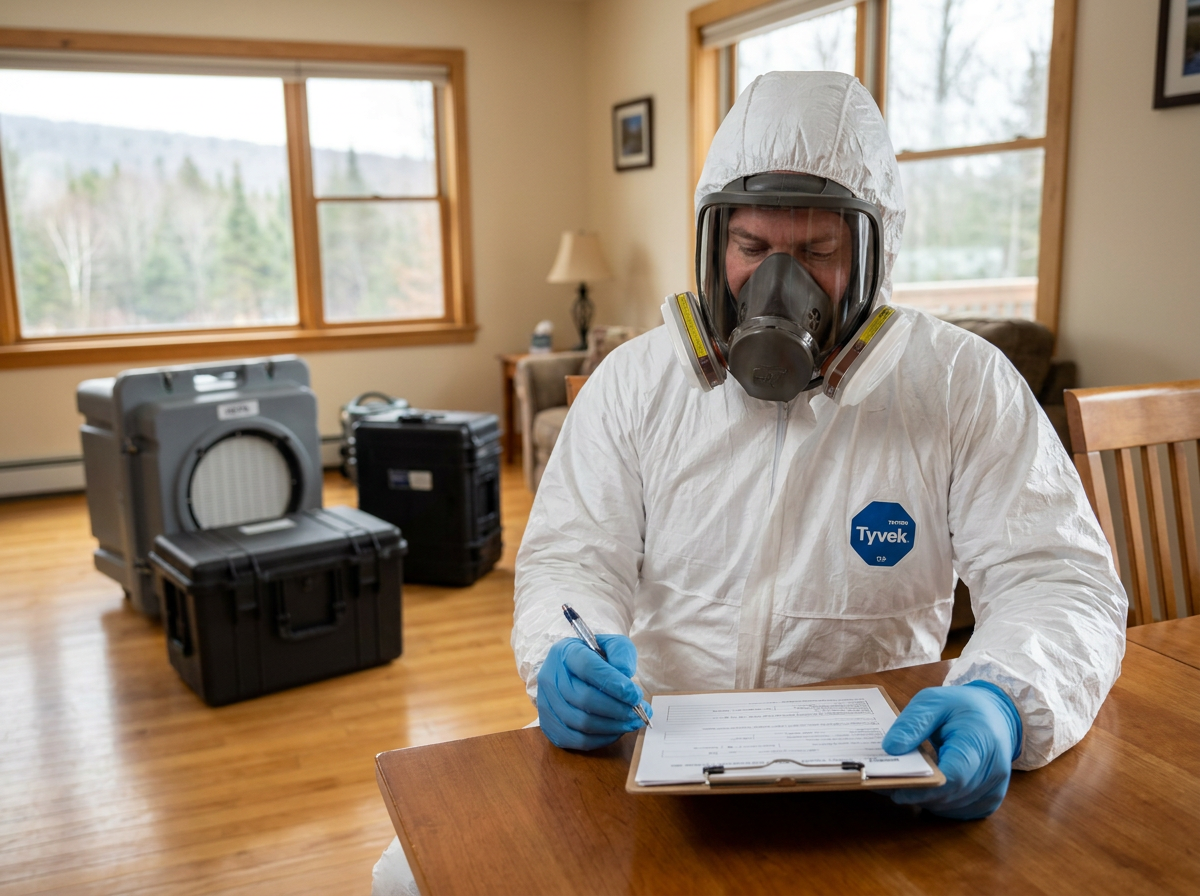
Full Tyvek suits, 3M respirators, nitrile gloves, boot covers, eye protection — approximately $75/day per worker, consumed and disposed of after each job.
EPA-registered disinfectants
Commercial-grade oxidizing and enzymatic agents that neutralize bloodborne pathogens. Not available in hardware stores at these concentrations.
Licensed biohazard waste disposal
Contaminated materials must be containerized, labeled, transported, and disposed of at a licensed facility. Pureway Compliance containers run ~$280 each.
HEPA filtration
Industrial HEPA air scrubbers (Abestorm Filteair 550, 800 sq ft each) run continuously during and after remediation to capture airborne particulates.
Ozone or hydroxyl treatment
Commercial ozone generators neutralize residual odor molecules after disinfection — required on any job involving decomposition or significant biological contamination.
Documentation
Chain-of-custody records, photographs, scope-of-work documentation, and clearance reports — required for insurance claims and legally significant for liability purposes.
These are not markup items — they are the actual cost of doing the work safely and legally. A company that quotes you significantly less than the ranges below either is not using this level of protection, or is planning to bill additional items after the job starts.
Biohazard Cleanup Cost by Job Type: Realistic Ranges for Northern New York
These ranges reflect actual project costs in our region — not inflated national averages. They account for Northern New York's specific disposal facility costs, rural travel requirements, and the older housing stock that often presents additional remediation complexity.
| Job Type | Typical Range | Notes |
|---|---|---|
| Blood spill cleanup — small, single area | $500 – $2,000 | Surface-limited, minimal structural penetration |
| Trauma scene — single room, significant contamination | $2,000 – $6,000 | Depends on surface porosity and penetration depth |
| Unattended death — discovered within 1–3 days | $3,000 – $8,000 | Limited decomposition, subfloor treatment likely |
| Unattended death — extended decomposition (1–4 weeks) | $6,000 – $15,000 | Fluid penetration into subfloor, structural removal likely |
| Unattended death — severe/prolonged (4+ weeks) | $10,000 – $25,000+ | Extensive structural remediation, sealing, full ozone |
| Suicide scene — gunshot or similar | $3,000 – $12,000 | Splatter pattern determines scope; walls and ceiling often involved |
| Crime scene — post-law enforcement release | $2,000 – $10,000 | Scope depends on type of crime and materials disturbed |
| Sewage backup — biohazard level | $1,500 – $6,000 | Category 3 water, structural drying and disinfection required |
| Feces/urine contamination — single room | $800 – $3,000 | Subfloor saturation extent is key variable |
All ranges include IICRC-compliant biohazard remediation, EPA-registered disinfection, licensed waste disposal, and documentation. Structural repair is billed separately if needed.
What Drives Cost Up or Down
Within any job type, several factors push the final number toward the high or low end of the range.
- •Extended time since the event — decomposition progresses rapidly and fluid penetration deepens every day
- •Porous materials — subfloors, drywall, insulation, carpet, and upholstered furniture absorb contamination and often require removal
- •Multiple rooms or floors affected
- •HVAC contamination — odors or particulates pulled into ductwork require duct cleaning
- •Mold discovered during remediation — requires separate IICRC-certified mold remediation scope
- •Remote location — travel adds to time and fuel cost
- •After-hours or emergency response
- •Event discovered quickly — less time for fluid penetration
- •Non-porous surfaces (sealed concrete, tile, sealed hardwood) — disinfection without removal
- •Single, contained room
- •No HVAC involvement
- •No mold or structural damage discovered
- •Property accessible and close to our service base
How Insurance Billing Works for Biohazard Cleanup
Insurance coverage for biohazard cleanup is one of the most misunderstood topics in our industry. Many families assume it is not covered; many discover it is. Here is how the billing process actually works.
Does Homeowner's Insurance Cover Biohazard Cleanup?
The answer depends on your specific policy and the circumstances of the event. Generally:
- •Unattended death or suicide on the property — many standard homeowner's policies include biohazard remediation as part of dwelling coverage when the event constitutes a covered loss
- •Crime scene cleanup following a covered event (break-in, assault) on the premises
- •Sewage backup causing biohazard contamination — if backup is from a covered cause and the policy includes water damage
- •Mold discovered during remediation, when originating from a covered water event
- •Events where the deceased was the named insured (some policies exclude this — check your policy language carefully)
- •Long-term gradual contamination not tied to a specific sudden covered event
- •Tenant-caused biohazard contamination in a rental — typically covered under landlord/dwelling policies, not tenant's renter's insurance
- •Hoarding-related biohazard — generally treated as neglect/maintenance rather than a covered peril
Do not assume it is not covered before calling. Many families never file a claim because they assume biohazard cleanup is excluded — and some pay out of pocket for jobs their policy would have covered. A 10-minute call to your insurance agent with our documentation in hand is always worth making first.
The Insurance Billing Process, Step by Step
When insurance is involved, here is how the process typically flows — and how we support you at each step.
File your claim promptly
Contact your insurer as soon as possible after the event. Delays can complicate coverage. You do not need a remediation estimate before filing — you just need to report the loss.
Request a biohazard-specialized adjuster
Standard property adjusters often have limited familiarity with biohazard remediation scope and pricing. Ask your insurer to assign an adjuster with experience in this type of claim. Out-of-area adjusters are common in Northern New York — approval can take 30–45 days with State Farm, Allstate, and other major carriers.
We document and provide a complete estimate
We provide full photographic documentation of the scene (before, during, and after), a detailed written scope of work with regulatory compliance citations, chain-of-custody records for biohazard disposal, and a line-item estimate in the format adjusters expect. This is the package your adjuster needs to approve the claim.
Wait for approval before work begins (insurance jobs)
For insurance-covered jobs, we wait for written approval before starting work — unless an emergency situation (active health hazard, structural risk) requires immediate action. Starting without approval risks the claim being denied. We will not put you in that position.
We work directly with your adjuster
Once approved, we communicate with your adjuster directly throughout the job — providing updates, documenting any scope changes, and submitting supplemental claims if additional contamination is discovered. You do not need to be the intermediary.
Final documentation and claim closure
On completion, we provide clearance documentation, final photographs, and a complete chain-of-custody record. This package is submitted to your insurer for final claim closure. Payment comes directly to us or through you, depending on your policy structure.
What About Rental Properties and Landlord Insurance?
Biohazard events in rental properties — an unattended death, a crime scene, a hoarding-related contamination left by a departing tenant — fall under landlord or dwelling fire policies rather than the tenant's renter's insurance. Landlord policies typically cover the structure and can include biohazard cleanup as part of the dwelling coverage.
Property managers and landlords working with us should have the policy number, insurer contact, and a description of the event ready when they call. We handle the documentation from there. For property managers dealing with this situation frequently, we can also provide a direct contact and streamlined intake process.
Government and Municipal Contracts
For municipal clients — city and county governments, housing authorities, tribal housing programs — we bill upon job completion after written authorization. We hold SDVOB and HUBZone certifications, which qualify our services for set-aside procurement with federal and state agencies. We currently hold an active contract with the City of Ogdensburg and serve multiple housing authority clients across the region.
Payment Terms for Private Clients
For clients paying privately (not through insurance or government contract), our standard terms are straightforward:
Private client payment structure:
- ✓Deposit: 50% of the estimate due before work begins. This secures your date and covers our initial equipment and materials.
- ✓Final payment: 50% due on job completion, after the final walk-through and before clearance documentation is issued.
- ✓Financing: Payment plans available through Acorn Financial for clients who need to spread the cost.
- ✓No hidden fees: Your estimate is your price. If additional contamination is discovered that expands the scope, we document it and get written authorization before proceeding — we do not bill for unapproved work.
Why You Should Not Delay Calling
The single most significant factor in biohazard cleanup cost is time. Decomposition fluids penetrate porous materials at a rate that accelerates with temperature — in the warm months that Northern New York experiences from May through September, the progression from surface contamination to subfloor saturation can happen in days. What is a $4,000 job if addressed within 24 hours can become a $12,000 job after a week of temperature-accelerated decomposition.
The same principle applies to sewage backup and mold — delayed remediation allows contamination to spread to previously clean areas, turning a contained problem into a whole-structure remediation. The cost of calling a professional sooner is almost always lower than the cost of calling later.
We are available 24 hours a day, 7 days a week — including holidays and weekends. After-hours calls do carry a surcharge for emergency response outside normal business hours, which we disclose upfront. In most cases, the cost of acting quickly is significantly less than the cost of waiting.
What Certified Biohazard Cleanup Includes — and What It Does Not
A certified biohazard remediation job includes everything required to return the affected area to a safe, habitable condition — but it does not include reconstruction. Here is the boundary.
Included in biohazard remediation
- ✓Removal and disposal of all contaminated porous materials (carpet, pad, drywall, insulation, subflooring)
- ✓EPA-registered disinfection of all remaining structural surfaces
- ✓Licensed biohazard waste containerization and disposal
- ✓Ozone and HEPA treatment for odor and airborne particulate elimination
- ✓Sealing of structural surfaces where odor penetration is present
- ✓Full photographic documentation and chain-of-custody records
- ✓Clearance documentation for property re-occupancy
Not included — separate contractor
- →Drywall replacement after removal
- →Subfloor replacement or structural repairs
- →Flooring installation (carpet, hardwood, tile)
- →Painting
- →Plumbing repairs (for sewage-related jobs)
- →Contents restoration (furniture, personal property cleaning)
We identify any structural damage during remediation and document it in our final report, which is exactly what your insurer and any reconstruction contractor will need. About half of our jobs require coordination with a structural or flooring contractor afterward — we provide referrals and work alongside other trades when needed.
Trauma Scene Cleanup and Suicide Cleanup: A Note on Families
For families dealing with the aftermath of a suicide or unattended death, cost is often the last thing they want to be thinking about — but it is an unavoidable reality. We try to make this as straightforward as possible:
- ✓We will work with your insurer directly so you do not have to manage the billing process while grieving
- ✓We explain the estimate clearly in plain language before any work begins
- ✓We do not use the emotional weight of the situation to rush or pressure decisions
- ✓If the insurance claim will take 30–45 days (common with major carriers), we can discuss a payment structure that allows work to begin while the claim is processed
Our guide to unattended death cleanup walks through what families can expect from the full process, including the insurance and billing steps. Our trauma scene cleanup service page describes what we do and how we approach these situations.
The IICRC Standard and Why It Matters for Your Claim
Insurance adjusters evaluating a biohazard cleanup claim look for documentation that demonstrates the work was performed to industry standards. The IICRC (Institute of Inspection, Cleaning and Restoration Certification) sets those standards for our industry — the same body that establishes the S500 standard for water damage and the guidelines for biohazard and crime scene remediation. IICRC-certified firms are trained to document work in ways that satisfy insurance documentation requirements, which reduces the likelihood of claims disputes and supplemental billing fights.
We are IICRC-certified. When we submit a claim package, adjusters receive documentation that meets their evidentiary requirements. This is not just a credential — it is directly relevant to how smoothly your insurance claim proceeds.
OSHA's Bloodborne Pathogens Standard compliance documentation also supports claims where the contamination involved bloodborne pathogen risk — demonstrating that all legally required safety protocols were followed.
Frequently Asked Questions
How soon will my insurance adjuster respond?
Response times vary by carrier and adjuster availability. In Northern New York, where many major insurance companies use out-of-area adjusters, we commonly see 30–45 day approval timelines with State Farm, Allstate, and similar carriers. Local and regional carriers often move faster. If an active health hazard requires immediate remediation before approval, we document the emergency conditions thoroughly and work with you to protect the claim.
Do I need to call my insurance company before calling you?
No — call us first. We can assess the scene, give you a sense of the scope, and help you understand what information your insurer will need. We will not start work until insurance approval is obtained (for insurance-billed jobs), but there is no reason to wait before getting an assessment.
What if my insurance denies the claim?
We will help you understand the denial reason and assess whether an appeal is worth pursuing. We can also provide a supplemental documentation package if the denial was based on incomplete information. If insurance ultimately does not cover the work, we work with you on private payment options including our financing program.
Is the cost different for a rental property vs. a primary residence?
The remediation cost is the same — it is based on scope, not property type. The billing structure may differ: rental property cleanup typically goes through a landlord or dwelling policy rather than homeowner's insurance, and government housing clients are billed on completion with written authorization.
Can you start work the same day I call?
For emergency situations where an active health hazard or safety risk requires immediate action, yes. For non-emergency jobs or insurance-billed work, we schedule based on assessment and approval. We respond to calls 24/7 and can typically be on-site within 24 hours for urgent situations across North Country NY.
What does the estimate include?
Every written estimate from us includes: itemized scope of work, PPE and materials costs, licensed biohazard disposal fees, ozone and HEPA treatment, documentation package, and any identified mold or structural concerns scoped separately. No line items are hidden, and no charges are added after the estimate is signed without a written scope change and your approval.
About Post Trauma Scene Decon
We are an SDVOB-certified and IICRC-certified biohazard and trauma remediation company in Northern New York, founded and led by a service-disabled veteran and former police officer and crime scene technician. Owner James Smith has over 20 years of experience. We hold IICRC certification, OSHA compliance, NYS DOL and DEC certification, BBB accreditation, SDVOB and HUBZone certification, and are the 2025 BBB Torch Award winner for Ethics. We serve all six North Country counties and respond 24/7.
Quick reference: What to have ready when you call
- Property address and access information
- Type of event and approximate date it occurred
- Rooms or areas visibly affected
- Your insurance carrier and policy number (if applicable)
- Whether the property is currently occupied
"The cost conversation is never easy when someone is in the middle of a tragedy. We try to make it as clear and straightforward as possible — because families deserve to understand exactly what they are paying for and why, without having to advocate for themselves while they are grieving." — James Smith, Founder
Post Trauma Scene Decon provides biohazard cleanup, trauma scene remediation, and mold remediation across St. Lawrence, Franklin, Clinton, Essex, Lewis, and Jefferson counties in Northern New York. IICRC certified. OSHA compliant. BBB accredited. SDVOB and HUBZone certified. 2025 BBB Torch Award for Ethics. Free on-site assessments. Available 24/7.
Get a Transparent, Written Estimate
We assess every job on-site before pricing. No phone guesses, no surprise charges. We work directly with insurance adjusters and document everything. Available 24/7 across North Country NY.
Call (315) 250-4462