If you are searching for trauma scene cleanup services right now, you are likely in the middle of one of the hardest moments of your life. We understand that. Our founder spent over 20 years working crime and trauma scenes as a police officer and technician — he built this company specifically to serve the families and communities that need this kind of help in Northern New York. We are available 24 hours a day, and we will treat your home and your family with the care and discretion you deserve.
Trauma scene cleanup — sometimes called biohazard remediation, crime scene cleanup, or forensic cleaning — is specialized work that requires more than a willingness to handle difficult situations. It requires proper certification, OSHA-compliant safety protocols, licensed biohazard waste disposal, and the technical knowledge to restore a property to a safe, habitable condition. In Northern New York, Post Trauma Scene Decon is the only company providing this level of certified trauma scene cleanup that is founded and led by someone who has personally worked these scenes — not just trained for them in a classroom.
This guide covers everything you need to know before you call: what trauma scene cleanup involves, why it cannot be handled by a general cleaning company, how quickly we respond across the six-county North Country region, what the process looks like from your first call to clearance, and how insurance typically handles the cost.
What Is Trauma Scene Cleanup?
Trauma scene cleanup is the professional remediation of any location where a traumatic event has occurred and left behind biological contamination — blood, bodily fluids, tissue, or decomposition matter. The term covers a wide range of situations:
Unattended death
When a person passes away and is not discovered for hours, days, or longer. Decomposition begins quickly and can require extensive structural remediation depending on the time elapsed.
Suicide scene
Cleanup of a scene following a suicide, including blood, biological material, and the emotional weight of the location. Requires full biohazard protocols and deep compassion.
Homicide or violent crime
After law enforcement has released the scene, professional cleanup removes all biological evidence of the crime and restores the space. We work on police-released scenes only.
Accidental trauma
Serious accidents on a property — industrial, vehicular, or domestic — that leave behind blood or biological contamination requiring certified remediation.
Death at home (attended)
Even when a death is attended and discovered promptly, the scene may require professional remediation — particularly for families who cannot or should not be responsible for the cleanup.
Bloodborne pathogen exposure
Any scene involving significant blood or biological material that poses a documented bloodborne pathogen risk — regardless of whether it involves a death.
What all of these have in common: the biological material present at a trauma scene is a documented health hazard. Blood and bodily fluids can carry HIV, hepatitis B, hepatitis C, and other bloodborne pathogens that remain viable on surfaces for significant periods. The Centers for Disease Control notes that bloodborne pathogen exposure is a serious occupational and environmental health concern — and exposure can occur through contact with contaminated surfaces, not just direct fluid contact. This is why trauma scene cleanup is regulated work, not cleaning.
Why Trauma Scene Cleanup Cannot Be Done by a General Cleaning Company
This is a question we hear regularly: can a family member handle it? Can a general cleaning service or junk removal company be called? The answer, for any scene with significant biological contamination, is no — and understanding why is important for the health and safety of everyone involved.
OSHA compliance requirements
OSHA's Bloodborne Pathogens Standard (29 CFR 1910.1030) requires that anyone working with materials potentially contaminated by blood or other potentially infectious material must use appropriate PPE, follow documented exposure control plans, receive proper training and annual refreshers, and handle and dispose of materials according to regulated procedures. A general cleaning company without this training and compliance framework cannot legally perform this work safely.
Licensed biohazard waste disposal
Biological waste from a trauma scene — contaminated materials, PPE, containers — must be disposed of at a licensed biohazard waste facility through a licensed transporter. It cannot go in a dumpster or a residential trash bin. This is a legal requirement, not a preference.
Porous material penetration
Blood and decomposition fluids penetrate porous surfaces — carpet, pad, drywall, wood flooring, subfloor, concrete — at a rate that depends on time and temperature. A surface that appears cleaned may still harbor biological material inside the material itself. Professional remediation assesses penetration depth, removes affected porous materials, and treats the underlying structure.
Odor and airborne contamination
Biological decomposition produces volatile organic compounds and airborne particulates that a mop and bleach cannot address. Commercial ozone generators, HEPA air scrubbers, and enzymatic treatments are required to clear residual airborne contamination and odor — equipment that general cleaning companies do not carry.
Documentation and chain of custody
For insurance claims, legal proceedings, and property records, trauma scene remediation must be documented with photographs, a scope-of-work record, regulatory compliance citations, and chain-of-custody records for biohazard waste disposal. A cleaning company cannot produce this documentation.
24-Hour Response Across North Country New York
When someone searches for trauma scene cleanup near them in Northern New York, they are almost always in an urgent situation. Speed matters — both for the health and safety of anyone present in or near the property, and because biological contamination progresses over time, deepening penetration into porous materials and increasing the scope and cost of remediation.
Post Trauma Scene Decon guarantees 24-hour response, 7 days a week, including holidays and weekends. That means from the time you call, we can be on-site within 24 hours anywhere in our six-county service area. In practice, for most of our service area, we arrive same-day.
Why response time matters for trauma scenes
Surface contamination, limited penetration into porous materials. Most manageable scope.
Fluid has begun penetrating subflooring and surrounding materials. Scope expands. Odor begins to develop.
Significant structural penetration. Subfloor removal likely. Active odor and potential HVAC contamination.
Extensive structural remediation required. Potential ceiling and wall contamination. Significantly higher cost.
Our six-county service area covers the full North Country region. We know the roads, the communities, and the unique challenges of rural response — including the remote areas of the Adirondacks and the St. Lawrence Valley where other companies decline to go or charge prohibitive travel fees. We price travel transparently and do not use remoteness as a reason to decline a call.
St. Lawrence County: Canton, Potsdam, Massena, Ogdensburg, Gouverneur, Morristown, Madrid, Norfolk, Waddington, Star Lake, Edwards, Cranberry Lake area
Franklin County: Malone, Tupper Lake, Saranac Lake, Burke, Brushton, Chateaugay
Clinton County: Plattsburgh, Rouses Point, Peru, Champlain, Mooers, Altona
Essex County: Lake Placid, Elizabethtown, Keene, Ticonderoga, Newcomb, Minerva
Lewis County: Lowville, Turin, Port Leyden, Croghan
Jefferson County: Watertown, Carthage, Sackets Harbor, Fort Drum area, Cape Vincent
Our Trauma Scene Cleanup Process: From First Call to Clearance
Here is exactly what happens when you call Post Trauma Scene Decon for a trauma scene. We believe you should understand every step before we arrive — because the more you know about the process, the more confident you can be that it is being handled correctly.
Initial call and scene assessment
When you call, we ask a few brief questions: the type of event, the location, approximately how long ago it occurred, and whether law enforcement has released the scene (required for any crime or death investigation). We do not need extensive detail over the phone — we assess the full scope on arrival. We confirm our response time and who will be on the team.
Scene setup and containment
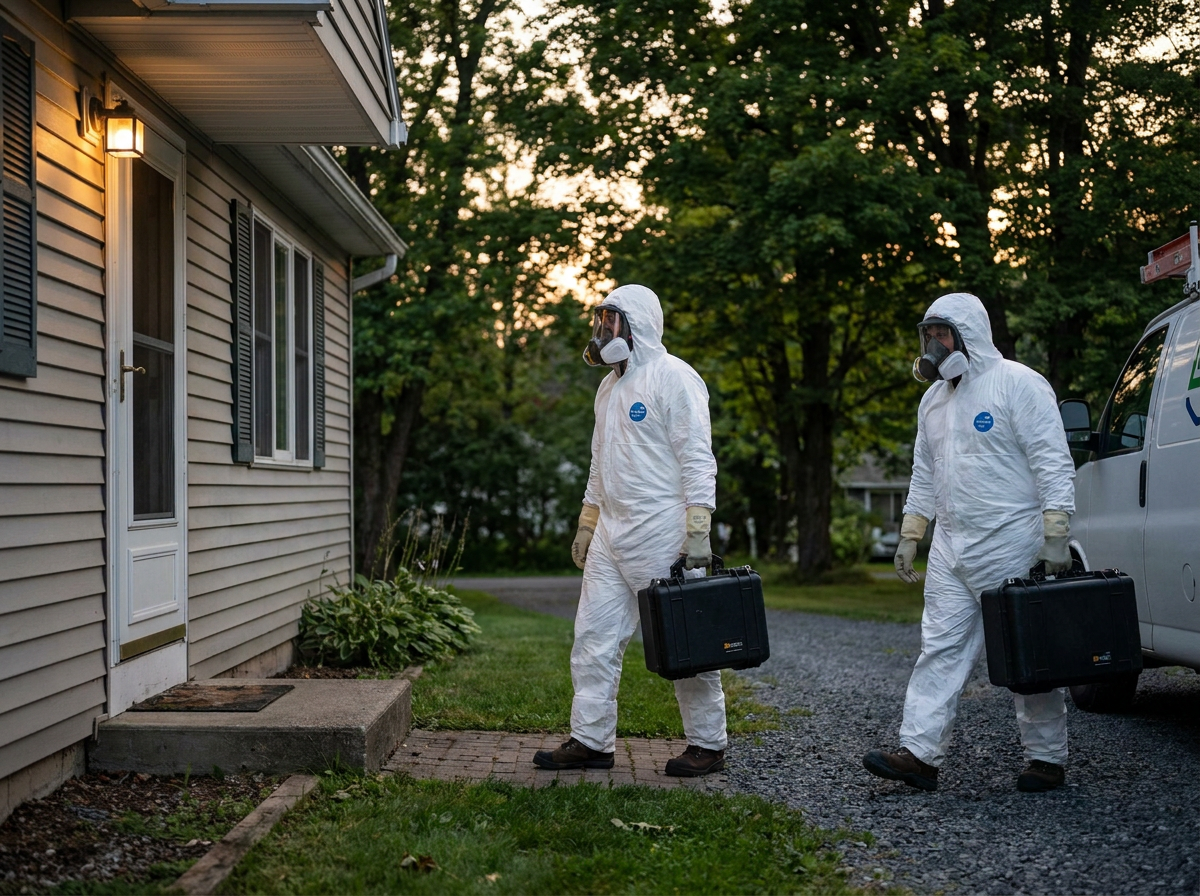
On arrival, the team establishes a work perimeter and containment to prevent the spread of biological material to unaffected areas of the home. HEPA-filtered negative air machines are set up to create negative air pressure inside the work area, ensuring contaminated air flows out through filtration rather than into clean spaces.
Photographic documentation
Before any material is disturbed, we document the scene thoroughly with photographs for insurance, legal, and chain-of-custody purposes. This record establishes the pre-remediation condition and supports your insurance claim.
Removal of contaminated materials
All porous materials that have absorbed biological contamination — carpet, pad, drywall, insulation, subflooring — are carefully removed and containerized in licensed biohazard containers (Pureway Compliance, up to 18 gallons, properly labeled). Non-porous surfaces that can be disinfected in place are treated rather than removed.
EPA-registered disinfection
All remaining structural surfaces in the affected area are treated with EPA-registered disinfectants — including oxidizing agents and enzymatic cleaners that neutralize bloodborne pathogens at the molecular level. We use RMR brand products rated safe for humans and animals once properly applied and dried.
Odor elimination
Commercial ozone generators and HEPA air scrubbers run after disinfection to neutralize residual odor molecules and airborne particulates. The property is cleared for re-entry only after air quality is confirmed safe. We run Abestorm Filteair HEPA 550 units capable of scrubbing up to 800 sq ft each with triple-stage filtration.
Sealing structural surfaces
Where biological material has penetrated structural elements that cannot be removed — concrete slabs, heavy timber, certain masonry — we apply odor-blocking sealant to lock in any residual compounds and prevent future off-gassing.
Final walk-through and clearance documentation
We conduct a thorough final walk-through before declaring the scene remediated. You or your representative are invited to inspect. We provide complete clearance documentation — photographs, scope-of-work record, regulatory compliance citations, and chain-of-custody records for all biohazard waste disposal.
Working With Law Enforcement and the Medical Examiner
One of the most important things families need to know: we do not enter or begin work on any scene involving a death or crime until it has been officially released by law enforcement and, where applicable, the county medical examiner or coroner.
This is not a procedural formality — it is a legal and investigative requirement. In Northern New York, the responding agencies include NYS State Police, local sheriff's departments, village and city police, and the county coroner's office. Once a scene is released, we can enter. Until then, we wait — and we make sure families understand why.
If any evidence is discovered during remediation that was not flagged by investigators — a physical object, documentation, anything that could be relevant to a continuing investigation — we stop work immediately, preserve the scene, and contact law enforcement before proceeding. This is standard protocol and it protects everyone.
Our founder's background as a former NYS Police officer means we understand how this coordination works from both sides. We communicate professionally with law enforcement agencies across the region, and that relationship makes the handoff from investigation to remediation smoother for the families involved.
Discretion and Privacy: How We Handle Sensitive Scenes
Trauma scenes carry stigma as well as grief. Families frequently ask us to be discreet — to arrive without obvious markings, to work without drawing neighbor attention, and to handle the situation in a way that protects the dignity of the person who passed and the privacy of the family.
- Unmarked vehicle arrival on request. We can arrive in unmarked vehicles when privacy is a priority. Just ask when you call.
- Discreet equipment setup. We work efficiently and without unnecessary external visibility. Equipment is staged inside or at the side of the property when possible.
- No visible biohazard signage at the property. While we maintain all required safety protocols, we keep the external presentation of the job low-profile when that is the family's preference.
- Strict confidentiality. We do not discuss job details, client identities, or property locations. The nature of this work demands complete discretion, and we maintain it.
- Compassionate communication throughout. Every conversation — from the first call to the final walk-through — is handled with care. We have been trained in compassionate communication with grieving families, and we take that responsibility seriously.
Insurance and Trauma Scene Cleanup: What Is Typically Covered
For many homeowners, renters, and property managers, trauma scene cleanup is covered by insurance — either a homeowner's policy, a landlord's dwelling policy, or in some cases a renter's policy. Coverage depends on the specific policy language and the nature of the event.
Generally, when a death or traumatic event occurs on an insured property and the cleanup is part of restoring the dwelling to a livable condition, the cost falls under the dwelling coverage of a standard homeowner's or landlord policy. We have navigated this process with State Farm, Allstate, Erie, and numerous regional carriers serving North Country clients. Approval typically takes 30–45 days with major out-of-area carriers.
For full information on how insurance billing works for biohazard remediation — including the step-by-step claims process and what documentation adjusters require — see our guide on biohazard cleanup cost and insurance billing. We handle the documentation and adjuster communication so you do not have to manage the claims process while grieving.
Why Certification Matters: What to Look for in a Trauma Cleanup Company
Not every company advertising trauma scene cleanup is equipped to perform it safely and legally. When evaluating a company — us or anyone else — look for the following.
- IICRC certification. The Institute of Inspection, Cleaning and Restoration Certification sets the industry standards for biohazard and trauma remediation. Certification requires formal training, demonstrated competency, and adherence to published standards.
- OSHA bloodborne pathogens compliance. Every technician should be trained under OSHA 29 CFR 1910.1030 with documented annual refreshers. Ask for proof of training if it matters to you.
- NYS DOL and DEC licensing. New York State requires specific licensing for companies handling and transporting regulated biohazard and hazardous waste. We hold current certifications from both the NYS Department of Labor and the Department of Environmental Conservation.
- BBB accreditation and verifiable references. We are BBB accredited and the 2025 BBB Torch Award for Ethics recipient. Any company you hire for this work should have a verifiable track record.
- On-site assessment before pricing. Trauma scene cleanup cannot be accurately priced over the phone. A company that gives you a firm number without seeing the scene is either guessing or padding. We assess every job on-site before providing a written estimate.
- 24-hour availability. Trauma scenes do not occur on business-hours schedules. A company that only responds during the day or requires you to wait until morning is not the right company for this work.
Who We Are: Post Trauma Scene Decon
Post Trauma Scene Decon is the only certified biohazard and trauma remediation company in Northern New York founded and led by a service-disabled veteran and former police officer and crime scene technician. Owner James Smith spent over 20 years working with NYS Police, including as a trained EAP member with specialized preparation for communicating compassionately with grieving families — experience that directly shapes how we work.
We are IICRC-certified, OSHA-compliant, NYS DOL and DEC licensed, BBB accredited, and SDVOB and HUBZone certified. In 2025, we received the BBB Torch Award for Ethics — recognition of the standard we hold ourselves to on every job. We are a locally rooted company serving St. Lawrence, Franklin, Clinton, Essex, Lewis, and Jefferson counties. No national franchise, no call center, no subcontracting — the people who answer your call are the people who will be on your property.
We keep a fully equipped team — including on-call technicians available 24/7 — so emergency response does not depend on a single person being available. Family members of our founder serve as trained, certified trauma scene workers, and we maintain a network of on-call professionals for larger or more complex jobs.
Frequently Asked Questions
How quickly can you respond to a trauma scene in North Country NY?
We guarantee a response within 24 hours anywhere in our six-county service area. For most locations — Canton, Potsdam, Massena, Malone, Plattsburgh, Watertown, and surrounding areas — we can be on-site same day. Remote locations in the Adirondacks and the far reaches of the St. Lawrence Valley may require a bit more travel time, but we do not decline calls based on location.
Can a family member clean a trauma scene themselves?
Family members should not attempt to clean a trauma scene. Beyond the significant emotional harm of doing so, biological material at a trauma scene poses real health risks — bloodborne pathogens including HIV, hepatitis B, and hepatitis C can remain viable on surfaces for extended periods. Proper remediation requires OSHA-compliant PPE, EPA-registered disinfectants, licensed biohazard waste disposal, and commercial air treatment equipment. This is not a job for household products and gloves.
Does insurance cover trauma scene cleanup?
In many cases, yes. Trauma scene cleanup tied to a death or traumatic event on an insured property is typically covered under the dwelling coverage of homeowner's, renter's, or landlord policies. We work directly with insurance adjusters and provide full documentation — photographs, scope of work, regulatory compliance citations, and chain-of-custody records — to support your claim. See our guide on biohazard cleanup cost and insurance billing for the full process.
How long does trauma scene cleanup take?
For a contained single-room scene discovered within 24 hours, cleanup typically takes 4–8 hours. For scenes involving extended decomposition, multiple rooms, or significant structural penetration, cleanup can take one to three days or more. We give you a realistic timeline estimate on arrival after assessing the full scope.
Do you work with the medical examiner or coroner?
Yes — in all cases involving a death, we wait for official scene release from law enforcement and the medical examiner or coroner before beginning work. We coordinate professionally with NYS State Police, county sheriffs, and local law enforcement agencies across the region. If evidence is discovered during remediation, we stop and notify law enforcement immediately.
Is the company local, or will you subcontract to someone else?
We are locally based and do not subcontract trauma scene work. The team that responds to your call is our team — trained, certified, and accountable to us directly. We maintain on-call coverage 24/7 and expand our crew for larger jobs by calling in certified on-call workers. Nobody who is not trained and certified under our standards works on a trauma scene.
What happens if the scene is a rental property?
Trauma scenes in rental properties are handled the same way as residential jobs — we work with whichever party has authorized access (property manager, executor, family member, or APS representative). We provide full documentation for insurance, legal, and housing authority purposes. Landlord and dwelling fire policies typically cover trauma scene cleanup on rental properties.
When you call Post Trauma Scene Decon, you can expect:
- ✓A calm, compassionate response — no pressure, no clinical detachment
- ✓24-hour availability — we answer when you call, day or night
- ✓Response within 24 hours anywhere in North Country NY
- ✓Full OSHA-compliant, IICRC-certified biohazard remediation
- ✓Discreet arrival and operation on request
- ✓Direct insurance coordination — we handle the documentation and adjuster communication
- ✓Written estimate before work begins, with no hidden charges
- ✓Clearance documentation and chain-of-custody records on completion
"I spent over 20 years responding to these scenes in uniform. I know what families go through when they get the call — the shock, the questions, the feeling of not knowing what to do next. I built this company so that when people in North Country need help, they can call someone who has actually been there and who will handle it with the care it deserves." — James Smith, Founder
Post Trauma Scene Decon provides trauma scene cleanup, biohazard remediation, crime scene cleanup, and death scene cleanup across St. Lawrence, Franklin, Clinton, Essex, Lewis, and Jefferson counties in Northern New York. IICRC certified. OSHA compliant. BBB accredited. SDVOB and HUBZone certified. 2025 BBB Torch Award for Ethics. Available 24/7.
Available 24/7 — We Respond Within 24 Hours
If you need trauma scene cleanup anywhere in North Country NY, call us now. We will listen, assess, and handle the rest — with the care and discretion your family deserves.
Call (315) 288-3670