The short version: remove the source first. Then use ozone or hydroxyl to neutralize the odor molecules left in the air and materials, and HEPA filtration to clear the particles. Skipping any of the three is why smells come back.
If you have searched for an odor removal service, you have probably seen a lot of talk about ozone generators and air scrubbers and not much explanation of what they do. This guide explains it plainly. For the full range of odors we treat in North Country New York, from pet urine to death odors, see our overview of professional odor removal in North Country NY. This post goes deeper on the equipment and the process.
Why Odor Is Hard to Remove
A smell is made of gas molecules and tiny particles released by a source. When that source is organic, such as urine, smoke residue, mold, sewage, or decomposition, the compounds soak into porous materials like drywall, wood, carpet pad, and insulation. They keep releasing for as long as the source is there. Wiping the surface removes what you can see. It does not remove what has soaked in.
That is why professional odor control is a sequence, not a single machine. The U.S. EPA makes a related point about indoor air in general: controlling the source is the most effective step, and cleaning the air is a supplement to that. You can read its overview of indoor air quality at EPA.gov.
Ozone, Hydroxyl, and HEPA: What Each One Does
These three tools solve different problems. Here is how they compare.
Ozone generator
- What it does:
- Oxidizes odor molecules and breaks them down in air and inside porous materials.
- Best for:
- Death, smoke, mold, and heavy organic odors in an empty, sealed property.
- Limit:
- Unsafe to breathe. The building must be vacated and aired out afterward.
Hydroxyl generator
- What it does:
- Uses UV light to produce hydroxyl radicals that break down odor compounds more gently and slowly.
- Best for:
- Moderate odors, or properties that cannot be fully vacated for long.
- Limit:
- Slower than ozone. Struggles with severe, deeply embedded odor.
HEPA air scrubber
- What it does:
- Pulls particles out of the air and traps them in filters: spores, soot, dust, and microbes.
- Best for:
- Every job. It cleans the air that ozone and hydroxyl cannot.
- Limit:
- Captures particles, not odor gases. It does not replace source removal.
Ozone treatment
Ozone (O₃) is an unstable form of oxygen. It reacts with odor molecules, mold spores, and bacteria and breaks them apart. Because it is a gas, it reaches fabrics, ductwork, and porous materials that liquid cleaners cannot. Commercial generators put out far more than consumer units, which is why they work on jobs where a plug-in does not.
Ozone is also a lung irritant. The EPA's guidance on ozone generators is clear that it can be harmful to breathe. We treat only vacated properties, keep people and pets out for the full cycle, and ventilate before anyone returns.
Hydroxyl treatment
Hydroxyl generators use UV light to make hydroxyl radicals, which break down odor compounds more gently than ozone. They are slower, and they suit moderate odors and situations where a property cannot be left empty. For severe or deeply embedded odors, ozone is usually the stronger tool.
HEPA filtration
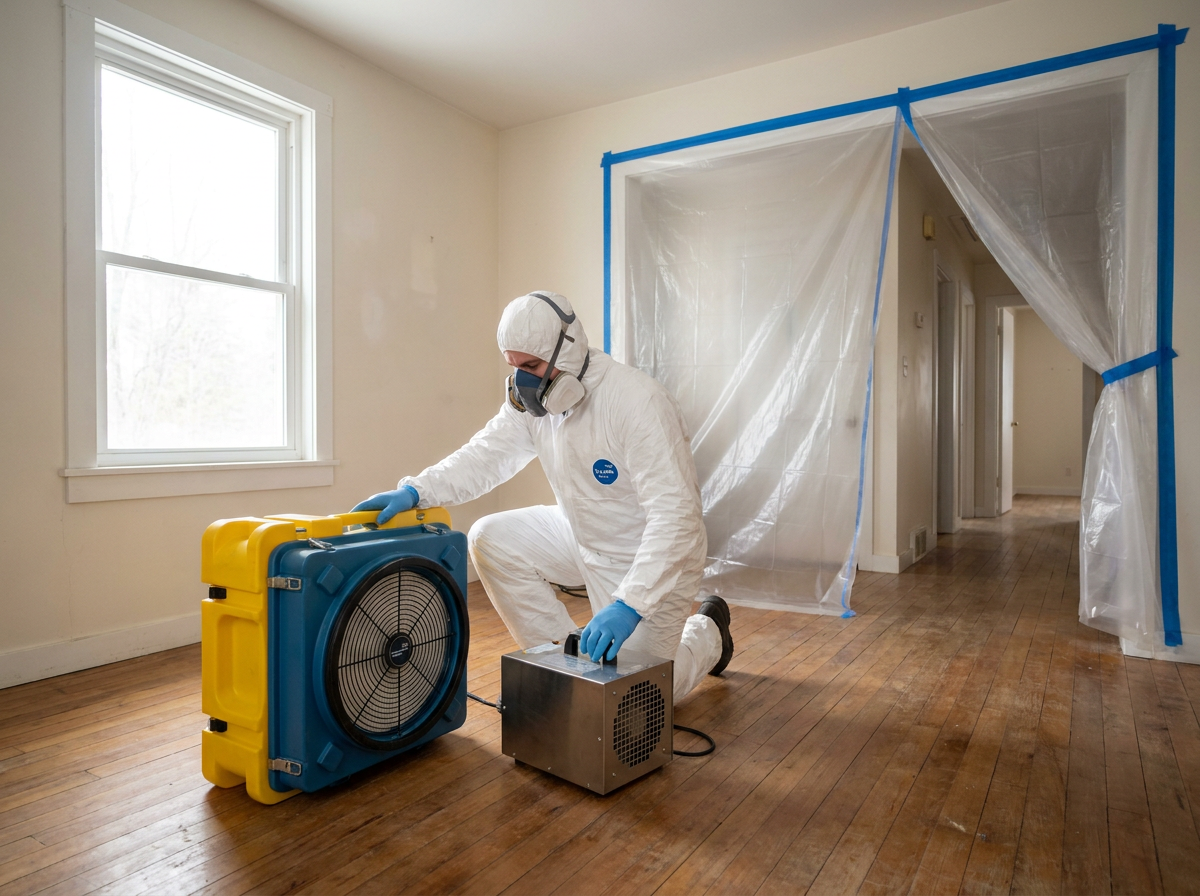
A HEPA air scrubber captures particles down to 0.3 microns. It does not neutralize odor gases, but it removes the spores, soot, dust, and microbes that carry odor and that remediation work stirs up. We run commercial HEPA units on every job, both inside containment during the work and afterward to clean the air before re-entry.
When you need both: any time the odor comes from a biological source such as decomposition, sewage, mold, hoarding, or heavy smoke. Ozone or hydroxyl handles the gases. HEPA handles the particles. Using one without the other leaves half the problem in the air.
Our Odor Removal Process, Step by Step
Find the source
We trace the smell to where it starts: a subfloor, a wall cavity, a duct, a crawlspace. Smell travels, so the strongest spot is not always the source.
Remove or treat the source
Contaminated drywall, pad, insulation, or flooring comes out. Surfaces that stay are cleaned and disinfected. No machine can fix a source that is still in the building.
Contain the work area
We seal the area by closing windows and doors, or with poly sheeting where that isn't possible, and run HEPA-filtered air scrubbers so particles and odor do not drift into clean rooms.
Run ozone or hydroxyl
With the property empty, we neutralize what is left in the air and in porous materials. The method depends on the odor and on whether people must stay on site.
Run HEPA filtration
Scrubbers capture the particles stirred up during the work and the ones the oxidizing step leaves behind.
Ventilate, verify, and seal if needed
We air the building out before anyone re-enters and walk the property with you. Where odor has soaked into structure we cannot remove, we apply a sealant.
Which Method Fits Which Odor
There is no single setting that works for every smell. The right combination depends on what is producing the odor and how far it has spread. These are the patterns we see most in North Country homes.
Pet urine
Urine salts settle into carpet pad and subfloor and reactivate when humidity rises. We remove the saturated pad, treat or seal the subfloor, and then use oxidizing treatment and HEPA to clear what is left in the air.
Smoke and nicotine
Residue coats walls and sits inside ducts. Surfaces and ducts are cleaned first. Ozone or hydroxyl then handles the odor that has soaked into soft materials and the structure.
Mold and musty smells
The smell comes from active growth, so the mold has to be remediated first. Odor treatment afterward clears the residual compounds. Treating the smell alone leaves the mold growing.
Decomposition and death odors
This is biohazard remediation. Contaminated porous materials are removed and disposed of properly, structure is disinfected and sealed where needed, and ozone with HEPA clears the air.
Sewage and hoarding odors
These are layered. Contaminated material is removed in phases, then the structure is treated, and oxidizing treatment and HEPA finish the job.
What to Expect on Treatment Day
Knowing the sequence ahead of time takes some of the stress out of it. For a job that includes ozone, this is what the day usually looks like.
- •We walk the property with you, confirm the scope in writing, and point out anything we found that changes the plan.
- •You move people and pets out. Plants and some sensitive items should go too. We will tell you what to take.
- •We seal the treatment area, set up the equipment, and start the cycle. Length depends on the size of the space and the severity of the odor.
- •When the cycle ends, we ventilate the building fully before anyone goes back in.
- •We do a final walk-through with you and document the work. If you are working with an insurer, we provide photos and a written scope for the claim.
Some materials near an ozone treatment are sensitive to oxidation, including certain rubber, natural-fiber items, and artwork. Tell us about anything valuable in the space so we can remove or protect it.
What Affects the Cost
We give a written estimate after we see the property, because the same smell can be a small job or a large one. The biggest factors are:
- •Whether the source has soaked into the structure and has to be removed
- •The square footage and number of rooms involved
- •How severe the odor is and how long it has been there
- •Whether biohazard handling, mold remediation, or duct cleaning is part of the scope
- •Travel to remote parts of the service area
Private clients pay 50% to schedule and the balance on completion, and payment plans are available through Acorn Financial. When the odor comes from a covered loss, we work with your adjuster and provide the documentation they ask for.
Five Odor Removal Myths That Cost People Time and Money
"An air purifier will fix it."
A purifier cleans the air that passes through it. It does not touch a source that is soaked into a wall, floor, or duct, so the smell keeps coming back.
"Bleach kills any smell."
Bleach is a surface disinfectant. It does not penetrate porous materials, and mixing it with other cleaners can create dangerous fumes.
"More ozone is always better."
Ozone only helps after the source is gone, and running it longer or stronger does not fix a source that is still there. It also raises the safety stakes.
"If I can't see anything, nothing is there."
Most odor sources are hidden: under flooring, inside walls, above ceilings, in ducts. Finding them is the first step of the job.
"The smell is gone, so the problem is gone."
Masking agents and fragrance can hide a smell for days. If the source is still present, the odor returns, often when the weather turns humid.
Each of these myths leads to the same result: money spent on products, weeks of living with the smell, and a bigger problem once the real source is finally found. If you have already tried a few of these, you are not alone. It is the most common story we hear on the first call, and it does not change what we can do for you.
When Odor Means Something Bigger
Some smells are a symptom of a problem that needs its own remediation. A musty smell usually means active mold, which needs proper mold remediation before any deodorizing will last. A death odor is a biohazard job that falls under trauma scene cleanup. In those cases the odor work is built into the remediation. You do not hire it separately. Our standalone odor removal service is for jobs where the odor is the main problem.
What to Look for in an Odor Removal Company
- Source removal first. A company that leads with a machine and skips the source will not fix the problem.
- Commercial equipment and a safety plan for ozone. Ask how they keep people and pets out and how they ventilate afterward.
- Certification. Look for IICRC-certified technicians. The IICRC sets the standards for restoration and cleaning work, and you can learn more at iicrc.org.
- A written scope before work starts. You should know what will be removed, treated, and sealed.
Learn about the IICRC and what its certifications cover before you hire anyone for serious odor work.
Serving North Country NY
Post Trauma Scene Decon is led by James Smith, a service-disabled veteran, former police officer, and crime scene technician with more than 20 years of experience. We are IICRC certified, OSHA compliant, and BBB accredited, and we hold SDVOB and HUBZone certifications. We serve St. Lawrence, Franklin, Clinton, Essex, Lewis, and Jefferson counties, including Malone, Plattsburgh, Watertown, Massena, Potsdam, and Canton, and we answer calls 24/7.
Frequently Asked Questions
Do I need ozone, HEPA, or both?
For most real odor problems, both. Ozone or hydroxyl deals with the odor molecules, and HEPA deals with the particles. They do different jobs. Which oxidizer we choose depends on the odor, how severe it is, and whether anyone has to stay in the building.
Is ozone safe?
Not to breathe at treatment levels. That is why we treat only empty buildings, keep people and pets out, and ventilate fully before re-entry. The EPA's guidance on ozone generators says the same thing.
Will the smell come back?
Not if the source was removed or sealed. When a smell returns after treatment, the source was usually left behind and only the air was treated.
Can I just rent an ozone machine?
You can, but it rarely works and it can be unsafe. Rented units are weaker and are often run in occupied rooms. They also do nothing about a source hidden in a wall or subfloor.
Is hydroxyl safer than ozone?
Hydroxyl treatment is gentler and can be used where a property cannot be fully vacated. It is also slower and less effective on severe odors. We choose based on how bad the odor is and who needs to be in the building.
Does homeowners insurance pay for odor removal?
It can when the odor comes from a covered loss, such as fire, a covered water event, or a biohazard situation. Odor from long-term neglect usually is not covered. We provide the photos and written scope adjusters ask for.
How long does it take?
A single-room job can take a day. Jobs with structural removal can take several days, including the ventilation period. We give a timeline after the on-site assessment.
Post Trauma Scene Decon provides odor removal, mold remediation, and biohazard cleanup across St. Lawrence, Franklin, Clinton, Essex, Lewis, and Jefferson counties in Northern New York. IICRC certified. OSHA compliant. BBB accredited. SDVOB and HUBZone certified.
Tell Us What You Are Smelling
We will find the source and give you a straight answer on what it takes to get rid of it. Available 24/7 across North Country NY.
Call (315) 250-4462