An odor is not the problem. It is the symptom. A smell that will not go away is almost always pointing to something you cannot see — biological residue in a subfloor, smoke particles trapped in drywall, mold colonizing behind a wall cavity, or decomposition fluids that have soaked into porous materials. Masking it does not fix it. Professional odor removal means finding the source, eliminating it, and then neutralizing what remains in the air. That is what we do.
If you are searching for an odor removal service near you in North Country, New York, you have likely already tried everything the hardware store has to offer. Plug-ins, enzyme sprays, ozone wands rented for the weekend, vinegar bowls, baking soda carpets. The smell may have dimmed for a day or two, then come back — because the source is still there. At Post Trauma Scene Decon, we provide professional odor elimination across St. Lawrence, Franklin, Clinton, Essex, Lewis, and Jefferson counties for the full range of odors a property can develop — from stubborn pet urine to the most difficult odor any building can hold: the smell of human decomposition.
The Odors We Eliminate
Odor removal is not one service. It is a category that covers completely different problems, each with its own chemistry, its own health implications, and its own remediation protocol. Before we talk about how the work is done, it helps to understand what we are actually treating.
Pet & urine odors
Urine salts crystallize in subflooring and carpet pads, releasing ammonia every time humidity rises. Surface cleaning will not reach them.
Smoke & fire residue
Smoke particles penetrate paint, drywall, and HVAC ducts. The sooty smell lingers for years if the structure is not properly treated.
Mold & mildew
The musty smell is microbial volatile organic compounds (MVOCs) — gases produced by actively growing mold. If you smell it, mold is present.
Cooking & grease buildup
Years of heavy cooking deposit polymerized grease on walls and ceilings that no household degreaser will fully remove.
Decomposition & death odors
The most severe category. Decomposition fluids penetrate porous materials and require biohazard remediation, not cleaning.
Sewage & waste odors
Sewer gas and backup residue carry hydrogen sulfide and bacteria. The smell signals an active sanitary hazard.
Hoarding accumulation
Layered odors from organic waste, pest activity, mold, and decay — each requiring its own phase of treatment.
Chemical & fuel odors
Solvents, fuel oil, pesticide residue, and drug lab byproducts require specialized decontamination.
What every one of these has in common: the smell you detect is not the source. It is the off-gas of the source. Until the source is physically removed or chemically neutralized, the odor returns. This is why a property can smell clean for a week after a DIY treatment and then "come back" — the treatment masked the off-gas temporarily but never addressed what was producing it.
Why Lingering Odors Are More Than a Nuisance
Persistent odors are often dismissed as a quality-of-life issue. In reality, the substances behind them are frequently health hazards. Mold odors indicate active fungal growth that can trigger respiratory issues, allergies, and asthma — particularly in children, older adults, and anyone with a compromised immune system. Decomposition and sewage odors carry bacteria and volatile organic compounds that you should not be breathing. Smoke residue contains fine particulates that lodge deep in the lungs.
The U.S. EPA notes that the air inside a home can be more polluted than the air outside, and that the sources of indoor air pollution range from biological contaminants to combustion byproducts to chemicals released by building materials. You can read the agency's overview on indoor air quality at EPA.gov. When an odor is strong enough to drive you to search for a professional, the underlying cause is almost always something worth addressing for health reasons alone — not just comfort.
How Professional Odor Removal Works: Our Process
At Post Trauma Scene Decon, odor remediation follows a structured IICRC-aligned process. We do not show up with a single machine and hope for the best. Every job is assessed, scoped, and treated based on what is actually causing the smell.
Source Identification
Before any treatment, we locate the source. Sometimes it is obvious — a known death, a sewage backup, a fire. Other times we are tracing an unknown smell to its origin: a wall cavity, an attic, a crawlspace, behind cabinetry. We use moisture meters, visual inspection, and experience to find what the nose is pointing at.
Source Removal
You cannot neutralize what you leave behind. Porous materials that have absorbed the source — drywall, subflooring, carpet pad, insulation — are removed and disposed of properly. This is the step DIY treatments skip, and it is the reason they fail.
Cleaning & Disinfection
All remaining surfaces are cleaned and disinfected with EPA-registered, human- and animal-safe chemicals (we use RMR brand products). For biohazard-related odors, this stage follows full bloodborne pathogen protocols with appropriate PPE.
Ozone Treatment
Where appropriate, we run commercial ozone generators to neutralize airborne odor molecules that have penetrated fabrics, ducts, and porous surfaces. The property is unoccupied during treatment — ozone is a powerful oxidant and not safe to breathe.
HEPA Air Filtration
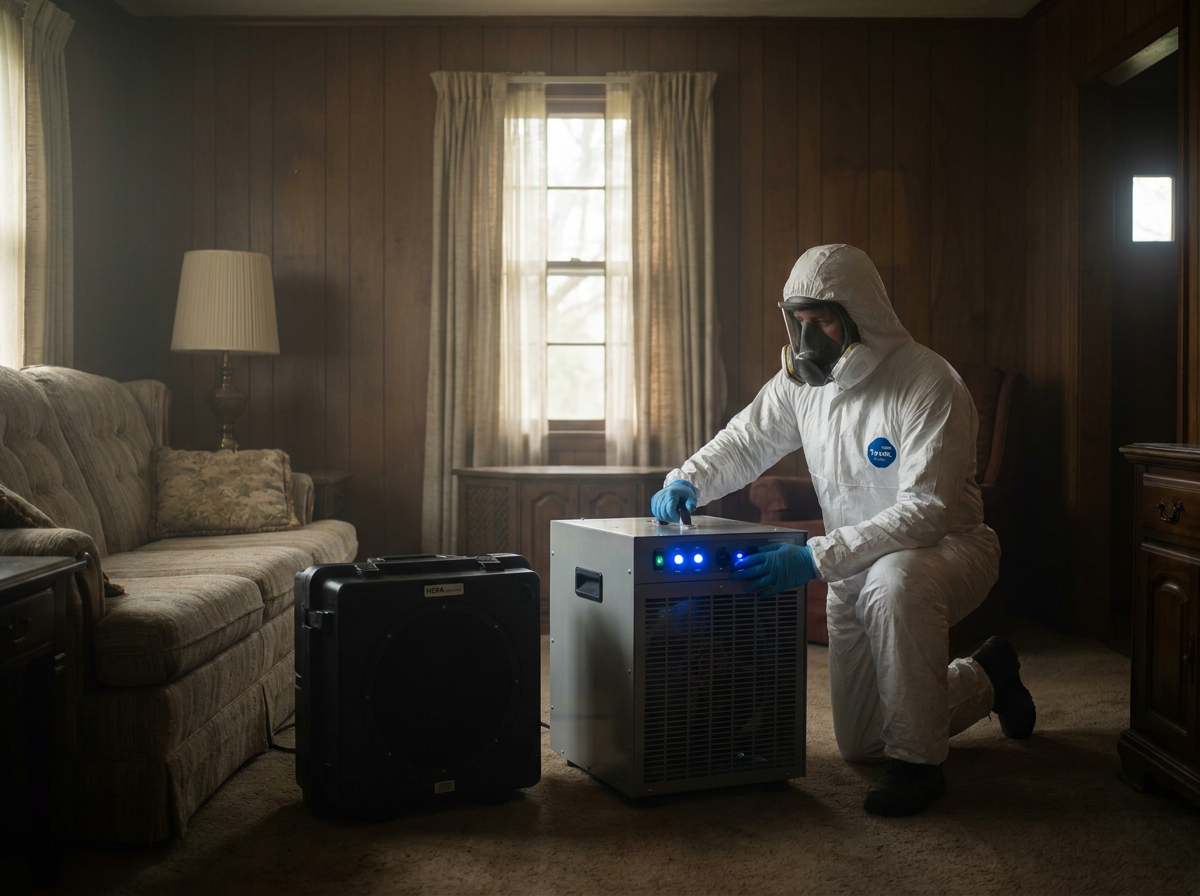
Industrial HEPA air scrubbers capture particulates down to 0.3 microns, pulling residual particles and microbes out of the air. We run Abestorm Filteair HEPA 550 units capable of scrubbing up to 800 sq ft each, with triple-stage filtration.
Sealing & Final Verification
If odors have penetrated structural materials that cannot be removed, we apply sealants to lock in any residual compounds. We then verify the property with a final walk-through and document the work for your records and any insurance claim.
Ozone Treatment: What It Is and When We Use It
Ozone is one of the most effective tools in professional odor removal — and one of the most misunderstood. An ozone generator produces O₃, an unstable form of oxygen that reacts with odor molecules, bacteria, mold spores, and chemical compounds, breaking them down at the molecular level. It reaches into fabrics, carpets, ductwork, and porous materials that liquid cleaners cannot touch.
It is also a respiratory irritant. Ozone is not safe to breathe at treatment concentrations, which is why a professional treatment always involves vacating the property, sealing the space, running the generator for a controlled period, and then fully airing the building out before anyone re-enters. The EPA's guidance on ozone generators is clear that these devices should only be used in unoccupied spaces. We follow that guidance on every job.
Why a rented ozone wand is not the same. Consumer ozone devices produce a fraction of the output of commercial equipment, are rarely run long enough to penetrate deeply, and are often used in occupied spaces — which is unsafe. If ozone could solve your odor with a weekend rental, you would not still be searching for a professional.
HEPA Air Filtration: Capturing What the Nose Cannot Smell
Ozone neutralizes gases; HEPA captures particles. After an odor source is removed and treated, the air itself still holds particulates — mold spores, soot, skin cells, dust carrying residual compounds, and microbes. Running HEPA air scrubbers pulls those particles out of the air and traps them in triple-stage filters before the property is cleared for re-occupancy.
This matters beyond odor. The CDC maintains that indoor air quality is a real public health concern, particularly where mold, combustion byproducts, or biological contaminants are present. Learn more from the CDC's indoor air quality resources. Our HEPA filtration step ensures that when we tell you a property is safe to re-enter, the air has actually been cleaned — not just deodorized.
Decomposition and Death Odors: The Most Specialized Category
Not every odor removal company can handle the smell of human decomposition — and most will not take the call. This is biohazard remediation, not cleaning, and it requires OSHA-compliant bloodborne pathogen protocols, full PPE, and licensed biohazard waste disposal. Decomposition fluids penetrate flooring, subflooring, baseboards, and even concrete. The odor they produce is among the most persistent a building can hold, and it does not respond to ordinary deodorizing.
This work is at the core of what we do. Our trauma scene cleanup service handles unattended deaths, suicides, and other scenes where biological remediation is required. If you are dealing with this situation, you can also read our guide on what happens after an unattended death — it walks families through the process honestly and without clinical language. In every decomposition case, odor elimination is part of the remediation, not a separate service: we remove the contaminated materials, disinfect the structure, and then run ozone and HEPA to clear what remains in the air. The goal is a property you can walk back into without being reminded of what happened there.
Odor and Mold: Why They Show Up Together
That musty, earthy smell is the signature of active mold growth. If you are noticing it in a basement, bathroom, or anywhere moisture collects in a North Country home, mold is almost certainly present — even if you cannot see it. Mold often colonizes inside wall cavities, under flooring, and in attics where it goes unnoticed until the smell becomes unavoidable.
Removing the moldy smell requires removing the mold itself. That is mold remediation — a separate discipline from general cleaning, governed by IICRC S500 standards. We are IICRC-certified for this work, and our mold remediation always includes preventive antimicrobial coating (RMR 141) to inhibit future growth. If you are searching for an odor removal service and the smell is musty, you likely need mold remediation first — the odor will not leave until the colony is gone.
Hoarding Cleanup and Layered Odors
Hoarding situations produce some of the most complex odor profiles we encounter — a combination of organic waste, mold, pest activity, decay, and accumulated household chemicals, each layered over years. There is no single treatment that addresses all of it. The odor is eliminated by working through the property phase by phase: bulk removal, biological decontamination, mold treatment, and then ozone and HEPA at the end. Our guide to hoarding cleanup services in Northern New York covers that full process. If a hoarded property is what you are dealing with, odor removal is built into the remediation — you do not need to hire a separate service.
Can You Remove These Odors Yourself? Usually, No
We understand the instinct to try. Odor problems are uncomfortable, and the products marketed to solve them are everywhere. But there is a consistent pattern to the calls we receive: the customer has already spent weeks or months and several hundred dollars on consumer products, and the smell is still there. Here is why DIY odor removal so often fails.
You cannot treat what you cannot reach
If urine has soaked into the subfloor, smoke has penetrated the drywall, or decomposition fluid has reached the concrete, no surface-level product will reach the source. The materials have to be removed or treated in place with commercial equipment.
Consumer ozone is not the same tool
Rented and plug-in ozone devices produce a small fraction of the concentration needed for deep penetration, and most instructions tell people to use them in occupied rooms — the opposite of safe practice. The EPA is explicit that ozone should only be used in unoccupied spaces.
Biohazard odors require biohazard protocols
Decomposition, sewage, and heavy hoarding odors carry biological hazards. Disturbing those materials without full PPE and proper containment can expose you to pathogens — and spread the contamination to clean areas of the property.
Masking is not eliminating
Fragrance products, candles, and enzymatic sprays can temporarily overwhelm the nose. They do not break down the compounds producing the odor. The moment the fragrance fades, the source is still there, still off-gassing.
What to Look for in an Odor Removal Service Near You
Not every company advertising odor removal is equipped for the full range of odors a property can develop. When you are evaluating who to call, especially for severe or biohazard-related odors, look for the following.
- IICRC certification. The Institute of Inspection, Cleaning and Restoration Certification sets the standards for professional remediation. IICRC-certified firms have completed formal training in odor control, decontamination, and restoration.
- Biohazard capability, not just deodorizing. If the odor may be linked to a death, sewage backup, or hoarding, you need a company that handles biohazard remediation — not a carpet cleaner. The protocols, PPE, and disposal requirements are completely different.
- Commercial equipment, not consumer gadgets. Real ozone generators, industrial HEPA air scrubbers, EPA-registered disinfectants, and moisture detection tools. If the company shows up with a handheld sprayer, that is not odor remediation.
- Local presence and 24/7 response. A national call center cannot reach a property in Malone, Potsdam, or Watertown quickly. We are based in North Country and respond to emergency calls 24 hours a day — often the same day you call.
- Honest assessment, not a sales pitch. A legitimate company will tell you when an odor can be treated and when materials need to be removed, and will give you a clear written scope before any work begins. We will not sell you a treatment we know will not hold.
Serving All of North Country NY
Post Trauma Scene Decon is an SDVOB-certified and IICRC-certified biohazard and trauma remediation company in Northern New York, founded and led by a service-disabled veteran and former police officer and crime scene technician. Owner James Smith brings more than 20 years of experience working in and around trauma scenes. We hold IICRC certification, OSHA compliance, NYS DOL and DEC certification, BBB accreditation, and SDVOB and HUBZone certification. In 2025, we received the BBB Torch Award for Ethics.
We serve the full North Country region: St. Lawrence County (Canton, Potsdam, Massena, Ogdensburg), Franklin County (Malone, Saranac Lake), Clinton County (Plattsburgh), Essex County (Ticonderoga, Lake Placid), Lewis County (Lowville), and Jefferson County (Watertown, Carthage). No property is too remote, and we respond to emergency odor and biohazard calls 24 hours a day, 7 days a week.
Frequently Asked Questions
How long does professional odor removal take?
It depends on the source and severity. A pet urine treatment in a single room may take a day. A full decomposition remediation with structural removal, ozone, and HEPA can take two to four days. We give you a clear timeline after the initial assessment.
Is ozone safe for my home and my family?
Ozone is safe when used correctly — in an unoccupied, sealed space, followed by full ventilation. It is not safe to breathe at treatment concentrations. We vacate the property, run the treatment, and air the building out completely before anyone re-enters. We follow EPA guidance on this on every job.
Will the smell come back?
If the source has been fully removed or neutralized, no. If a treatment only masks the odor without addressing the source, it will return — which is why our process always starts with source identification and removal, not just deodorizing.
Can you remove the smell after a death or unattended passing?
Yes. This is biohazard remediation and one of the core services we provide. Decomposition odors require removal of contaminated porous materials, full disinfection, and then ozone and HEPA treatment. This is not a job for a general cleaning company.
Does insurance cover odor removal?
It depends on the cause and your policy. Odor removal tied to a covered event — a fire, a water damage claim that led to mold, a biohazard remediation — is often covered. We provide full documentation for your insurer and can work directly with your adjuster.
How much does professional odor removal cost in North Country NY?
Pricing depends on the source, the size of the affected area, and whether structural removal is required. We provide a written estimate before any work begins — no hidden fees, no surprises. Financing is available through Acorn Financial for clients who need it.
When you call Post Trauma Scene Decon, you can expect:
- ✓A calm, honest conversation — no pressure, no upselling
- ✓A clear assessment of what is causing the odor and what it will take to eliminate it
- ✓A written estimate before any work begins
- ✓24/7 availability — we answer when you call
- ✓Discreet arrival in an unmarked vehicle upon request
- ✓Direct insurance coordination when applicable
- ✓Full documentation for insurance, estate, or legal purposes
- ✓A property you can re-enter without the smell following you back in
"If you can still smell it, the job is not done. Our job is to get to the point where you walk back in and notice nothing — because there is nothing left to notice." — James Smith, Founder
Post Trauma Scene Decon provides professional odor removal across St. Lawrence, Franklin, Clinton, Essex, Lewis, and Jefferson counties in Northern New York. IICRC certified. OSHA compliant. BBB accredited. SDVOB and HUBZone certified. 2025 BBB Torch Award for Ethics. Call 24/7.
Need an Odor Removed? Let's Find the Source.
Tell us what you are smelling and when it started. We will give you an honest assessment of what it will take to eliminate it — and we respond 24/7.
Call (315) 250-4462